

Corporate Governance
Our corporate philosophy is “contributing to healthcare through the development and sale of advanced, high-quality medical devices.” By engaging in businesses related to healthcare, we fulfill our social mission and responsibilities. At the same time, to maintain and enhance trust-based relationships with shareholders and other stakeholders, we strive to strengthen our corporate governance with the aim of achieving the Company’s sustainable growth and enhancing corporate value over the medium to long term.
1. Basic Approach to Corporate Governance
From the perspective of ensuring the sustainable growth and medium- to long-term enhancement of corporate value for our group, we believe that the core of corporate governance lies in ensuring transparency and fairness in our decision-making, making effective use of management resources, and increasing business vitality through swift and decisive decision-making. In line with the following basic principles, we are committed to enhancing our corporate governance.
-
Respect the rights of shareholders and ensure their equality.
-
Consider the interests of stakeholders, including shareholders, and appropriately cooperate with these stakeholders.
-
Appropriately disclose company information and ensure transparency.
-
Establish a structure in which independent outside directors (including Audit and Supervisory Committee members) play a central role in ensuring transparency and fairness in decision-making, and ensure highly effective supervision of business execution by the Board of Directors from an independent and objective standpoint.
-
Engage in constructive dialogue with shareholders to a reasonable extent.
- 「Basic Corporate Governance Policies」PDF
- 「Policy and Procedures for the Nomination of Director and Audit & Supervisory Committee Member Candidates」PDF
- 「Realization of management conscious of cost of capital and stock price」PDF
- 「Status of Dialogue with Shareholders (Fiscal Year Ended March 31, 2026)」PDF
2. Corporate Governance Structure
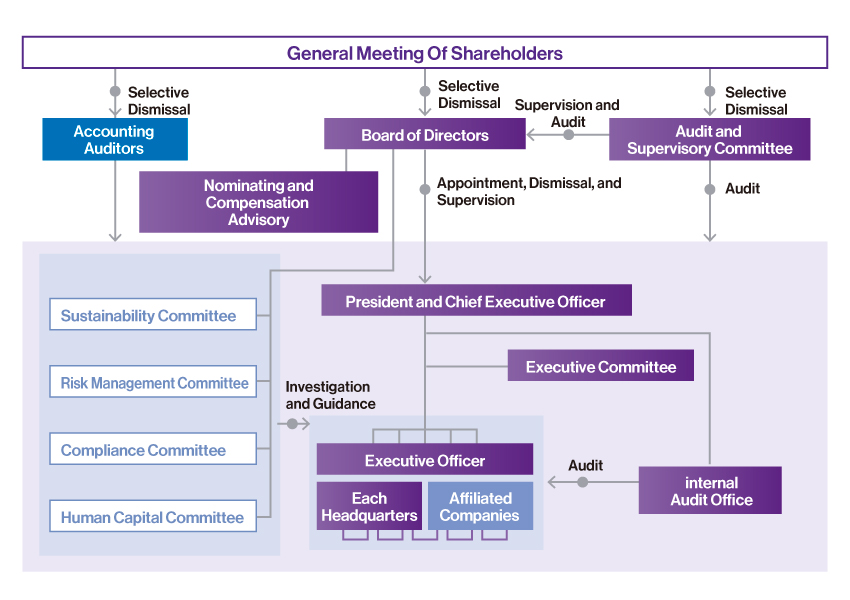
1. Supervision
(1)Board of Directors
The Board of Directors (including Audit and Supervisory Committee members), bearing fiduciary and accountability responsibilities to shareholders, deliberates and decides on important management matters such as management strategies and business plans to ensure the Company’s sustainable growth and medium- to long-term enhancement of corporate value. Furthermore, the Board supervises the overall management of the Group by receiving reports on the business execution status by executive officers, the status of important business execution at subsidiaries, compliance and risk management at the Company and its subsidiaries, and the promotion of sustainability, among other matters.
In addition, the Board of Directors (including Audit and Supervisory Committee members) defines its approach regarding the balance, diversity, and size of the Board as a whole in terms of knowledge, experience, insight, and ability. Taking the overall business environment into account, the Board is composed of members who are deemed optimal in terms of overall balance, regardless of gender, race, nationality, etc., with the best combination of knowledge, experience, and abilities of each director (including Audit and Supervisory Committee members). The Company also appoints multiple independent outside directors (including those who are Audit and Supervisory Committee members), reflecting opinions from individuals with extensive experience and insight, such as outside business executives and legal experts, in its management policy.
(2)Nomination and Remuneration Advisory Committee
The Company has established a Nomination and Remuneration Advisory Committee as an advisory body to the Board of Directors. A majority of the members of the Nomination and Remuneration Advisory Committee are independent outside directors, and the chairperson is also an independent outside director.
Role of the Nominating and Compensation Advisory Committee
- ① The Committee makes recommendations to the Board of Directors regarding the appointment and dismissal of candidates for directors (including Audit and Supervisory Committee members), executive officers, and Audit and Supervisory Committee members.
- ② The Committee examines the policies regarding remuneration for directors (including Audit and Supervisory Committee members) and executive officers, as well as the details of individual remuneration, and makes recommendations to the Board of Directors.
- ③ The Committee appropriately evaluates company performance and makes recommendations to the Board of Directors so that such evaluations are reflected in the remuneration of each director and executive officer.
(3)Sustainability Committee
The Sustainability Committee deliberates on cross-sectional policies, strategies, and plans related to the promotion of sustainability within our group. Recognizing that addressing sustainability issues, such as those indicated in the SDGs, is a material issue (materiality) that not only reduces business continuity risks but also leads to revenue opportunities, the Company aims to fulfill its social responsibility (CSR) for the development of a sustainable society by proactively and actively addressing these issues.
(4)Risk Management Committee
The Company has established the Risk Management Committee to formulate policies and plans for risk management, with the aim of raising risk awareness and the early identification of various risks surrounding the Group’s businesses.
(5)Compliance Committee
To foster a corporate culture that emphasizes compliance, the Company has established a Compliance Committee to formulate policies and plans for legal and regulatory compliance.
(6)Human Capital Committee
Under the “Basic Policy on Sustainability Initiatives,” the Company has established the Human Capital Committee with the aim of promoting activities related to human capital management.
2.Business Execution
(1)Executive Officers’ Meeting
The Executive Officers’ Meeting is established as a body to deliberate and resolve important matters that require prior discussion before submission to the Board of Directors, as well as other significant matters related to business execution.
3.Audit
(1)Audit and Supervisory Committee
The Audit and Supervisory Committee, as an independent body entrusted by shareholders, audits the execution of duties by directors, the Company’s internal controls, business performance, financial condition, and other matters. Specifically, the Audit and Supervisory Committee members attend not only Board of Directors meetings but also the Executive Officers’ Meeting, Management Meetings, and other key internal meetings. In addition, the Committee members regularly exchange opinions with the President, executive officers, and others, and on a monthly basis, they receive and review approval documents and the minutes of the Executive Officers’ Meeting and Management Meetings.
Furthermore, by exercising their authority in the selection and dismissal of external accounting auditors and the determination of audit compensation, the Audit and Supervisory Committee fulfills its roles and responsibilities for ensuring transparency and fairness in accounting audits.
(2)Internal Audit Office
The Internal Audit Office conducts audits of accounting and operations for the Company Group, including subsidiaries, and reports audit results to the Board of Directors. Audits are conducted in cooperation with the Audit and Supervisory Committee members, accounting auditors, and the Internal Audit Office.
(3)Accounting Auditor
The Company’s accounting auditor is Taiyo LLC.
3. Basic Policy on Internal Control Systems
1. System to Ensure that the Execution of Duties by Directors of the Company and Its Subsidiaries Complies with Laws and Regulations and the Articles of Incorporation
-
In accordance with the Group’s Code of Conduct for Officers and Employees and the Compliance Committee Regulations, we will prevent violations of laws and regulations before they occur.
-
A framework will be established to enable confirmation of legal compliance by attorneys or other experts, as necessary, with respect to business execution.
2. System for the Preservation and Management of Information Related to the Execution of Duties by Directors of the Company
-
Information related to the execution of duties by directors of the Company shall be recorded in documents or electromagnetic media and shall be appropriately preserved and managed in accordance with the Document Management Regulations and other relevant rules.
-
Directors of the Company and the Audit and Supervisory Committee shall be entitled to access these documents at any time in accordance with the Document Management Regulations and other relevant rules.
-
Any amendment to the Company’s Document Management Regulations or other relevant rules shall require the approval of the Audit and Supervisory Committee.
3. Regulations and Other Systems for Managing the Risk of Losses at the Company
-
In accordance with the Company’s Risk Management Regulations and other internal rules, the Company shall comprehensively identify, assess, and manage risks that may have a significant impact on the corporate value of the Group, including risks related to business, finance, legal affairs, quality, regulatory affairs, information security, compliance, transactions with medical institutions and others, transactions with distributors, anti-bribery, conflicts of interest, sustainability, and other matters.
-
Material risks and the status of responses thereto shall be reported periodically to the Board of Directors and the Audit and Supervisory Committee by the relevant departments or committees.
- In the event of a serious accident, disaster, misconduct, or violation of laws and regulations, the Company shall promptly establish a response headquarters headed by the President or other necessary structures, in order to prevent the expansion of losses, investigate the causes, implement corrective measures, and prevent recurrence.
4. System to Ensure the Efficient Execution of Duties by Directors of the Company
-
The Company adopts an executive officer system, under which executive officers are appointed by resolution of the Board of Directors and execute their duties within the scope defined based on delegation by the Board of Directors and under its decisions.
-
The Board of Directors establishes a Group medium-term management plan covering a period of three fiscal years and clarifies the targets to be achieved by the Group as a whole.
-
The Board of Directors actively utilizes the Executive Officers’ Meeting, Management Meetings, and other forums to ensure the efficient execution of duties by directors.
- In accordance with the Company’s Organizational Regulations and Rules on Division of Duties, the responsible departments, authority, and other matters are clearly defined.
5. System to Ensure that the Execution of Duties by Employees of the Company Complies with Laws and Regulations and the Articles of Incorporation
-
In accordance with the Code of Conduct for Officers and Employees, the Compliance Committee Regulations, and other internal rules, the compliance officers and the department in charge of compliance shall prevent violations of laws and regulations before they occur, and shall also ensure early detection, investigation, corrective action, and prevention of recurrence.
- The Compliance Committee shall periodically report to the Board of Directors and the Audit and Supervisory Committee on material compliance matters, the status of internal whistleblowing reports, the implementation status of education and training, the progress of corrective measures and recurrence prevention measures, and their effectiveness.
- The Company’s Internal Audit Office, which is responsible for internal audits, shall evaluate the effectiveness of the development and operation of the compliance system.
6. System for the Development and Operation of the Company’s Internal Whistleblowing System
-
The Company shall establish an internal whistleblowing system that enables officers, employees, and others of the Group to report or seek consultation on illegal or inappropriate conduct, improper disclosure, compliance concerns, or other serious issues without fear of suffering disadvantageous treatment, and shall establish both internal contact points and external contact points independent from management.
-
The Company shall protect the confidentiality of whistleblowers and persons seeking consultation and shall prohibit any disadvantageous treatment on the grounds of such reporting or consultation.
-
The operation status of the internal whistleblowing system, summaries of material reports, and the implementation status of investigations, corrective measures, and recurrence prevention measures shall be periodically reported to the Board of Directors and the Audit and Supervisory Committee.
7. System for Reporting to the Company on Matters Related to the Execution of Duties by Directors of Subsidiaries
-
The Company shall hold subsidiary officers’ meetings and other regular meetings attended by directors and others of the Company and its subsidiaries, and shall require subsidiaries to report to the Company on performance, finance, internal controls, quality, regulatory affairs, legal matters, compliance, risk management, and other important matters.
- In the event that a material matter occurs or is likely to occur at a subsidiary, the subsidiary shall be required to report such matter promptly to the Company.
8. Regulations and Other Systems for Managing the Risk of Losses at Subsidiaries
- In accordance with the Risk Management Regulations governing risk management for the Group, the Company shall designate a person responsible for managing each individual risk and shall comprehensively and centrally manage risks across the Group as a whole.
9. System to Ensure the Efficient Execution of Duties by Directors, etc. of Subsidiaries
- The Company shall formulate a Group medium-term management plan covering a period of three fiscal years and, in order to give concrete form to such medium-term management plan, shall establish Group-wide priority targets for each fiscal year.
10. System to Ensure that the Execution of Duties by Employees of Subsidiaries Complies with Laws and Regulations and the Articles of Incorporation
- The Company shall provide annual training on legal compliance and related matters to directors and employees of the Group in order to foster awareness of compliance.
11. System to Ensure the Appropriateness of Operations within the Group Consisting of the Company and Its Subsidiaries
-
Based on the Subsidiary Management Regulations, Authority Regulations, Rules on Division of Duties, and other internal rules, the Company shall require prior consultation with, approval by, or reporting to the Company regarding important matters of subsidiaries.
-
Transactions with subsidiaries shall also be reviewed under standards equivalent to those applied to transactions with third parties in order to ensure their appropriateness.
-
The Company shall ensure the appropriateness of operations across the Group through audits of subsidiaries by the Internal Audit Office, regular meetings with subsidiaries, compliance training, the internal whistleblowing system, and confirmation of the development and operation of reporting channels for material matters.
12. Matters Concerning Directors and Employees Who Assist in the Duties of the Audit and Supervisory Committee
- If the Audit and Supervisory Committee requests the appointment of directors or employees to assist in the performance of its duties, the Board of Directors shall, upon consultation with the Audit and Supervisory Committee, establish the necessary framework.
13. Matters Concerning the Independence of Directors and Employees Who Assist in the Duties of the Audit and Supervisory Committee from Directors Who Are Not Audit and Supervisory Committee Members
-
Directors or employees who assist in the duties of the Audit and Supervisory Committee shall follow the instructions and orders of the Audit and Supervisory Committee with respect to such duties, and their independence from directors who are not Audit and Supervisory Committee members and from business execution divisions shall be ensured.
-
The appointment, transfer, evaluation, disciplinary action, and dismissal of such employees shall be subject to the consent of, or opinions from, the Audit and Supervisory Committee.
14. Matters Concerning Ensuring the Effectiveness of Instructions to Directors and Employees Who Assist in the Duties of the Audit and Supervisory Committee
-
Directors or employees who assist in the duties of the Audit and Supervisory Committee shall follow the instructions and orders of the Audit and Supervisory Committee with respect to such duties.
-
Directors and employees of the Company shall provide necessary information and cooperation to those assisting the Audit and Supervisory Committee so that the Committee’s duties may be performed smoothly and effectively.
15. System for Directors, Employees, and Others of the Company and Its Subsidiaries to Report to the Audit and Supervisory Committee
-
Officers and employees of the Group shall promptly report to the Audit and Supervisory Committee whenever they become aware of any act or potential act that violates laws and regulations, the Articles of Incorporation, internal rules, the Code of Conduct for Officers and Employees, or other compliance requirements; any fact that may cause significant damage to the Company or its subsidiaries; any matter that may materially affect the reliability of financial reporting; or any other matter for which the Audit and Supervisory Committee has requested reporting.
-
The same shall apply to officers and employees of subsidiaries, as well as to officers and employees of the Company who receive reports from such persons.
-
The Compliance Committee, the department in charge of risk management, the Internal Audit Office, and the department in charge of the internal whistleblowing system shall report to the Audit and Supervisory Committee on the status of internal whistleblowing reports, material compliance matters, investigation results, corrective measures, and the implementation status of recurrence prevention measures on a regular basis, and promptly in the case of material matters.
16. System to Ensure That Persons Who Report to the Audit and Supervisory Committee Are Not Subject to Disadvantageous Treatment on Account of Such Reporting
- The Company prohibits any disadvantageous treatment of officers, employees, and others of the Group who make reports to the Audit and Supervisory Committee or who make reports or seek consultation through the internal whistleblowing system on the grounds of such reporting or consultation, and shall thoroughly communicate this policy to all officers and employees of the Group.
17. System for the Processing of Expenses Incurred in the Execution of Duties by Audit and Supervisory Committee Members
- The Company shall establish procedures for claims for expenses incurred in the execution of duties by Audit and Supervisory Committee members. If an Audit and Supervisory Committee member makes a claim for advance payment, reimbursement, or the like of such expenses, the Company shall promptly process the relevant expense or liability unless it is deemed that the claim is unnecessary for the execution of the duties of the Audit and Supervisory Committee member.
18. Other Systems to Ensure the Effectiveness of Audits by the Audit and Supervisory Committee
-
The Company shall provide the Audit and Supervisory Committee with opportunities to conduct interviews with directors and employees, and shall hold regular meetings for the exchange of opinions with the Representative Director, the Internal Audit Office, and the accounting auditor, respectively.
-
A full-time Audit and Supervisory Committee member, or an Audit and Supervisory Committee member designated by the Audit and Supervisory Committee, shall attend meetings of the Compliance Committee as necessary.
19. Audit and Reporting System by the Internal Audit Office
-
The Internal Audit Office shall conduct audits of the appropriateness of business execution, including internal controls, risk management, compliance, internal controls over financial reporting, and other matters within the Group, and shall periodically report the results and the status of improvements to the Representative Director and President, the Board of Directors, and the Audit and Supervisory Committee.
-
If the Internal Audit Office becomes aware of any material deficiency or any potential violation of laws and regulations, it shall promptly report such matter to the Representative Director and President, the Chairperson of the Board of Directors, and the Audit and Supervisory Committee.
-
The Internal Audit Office shall regularly exchange information with the Audit and Supervisory Committee and the accounting auditor to ensure the effectiveness of audits.
20. System to Ensure the Accuracy and Reliability of the Company’s Financial Reporting
-
The Company shall establish the “Accounting Regulations,” the “Consolidated Financial Closing Guidelines,” and other internal rules, and, under the direction of the General Manager of the Administration Division, shall enhance the framework for ensuring the accuracy of financial reporting by complying with accounting standards and other relevant laws and regulations.
-
To ensure the reliability of financial reporting, the Internal Audit Office shall periodically evaluate whether the system for ensuring the accuracy of financial reporting is functioning properly and report the results to the Representative Director and President. In addition, the Audit and Supervisory Committee and the Internal Audit Office shall conduct audits to reduce and prevent the risk of material misstatements in financial reporting, thereby ensuring that internal controls function effectively.
21. System for the Elimination of Anti-Social Forces
-
The “Code of Conduct for Officers and Employees” stipulates that the Company shall have no relationship whatsoever with anti-social forces and shall respond firmly to any improper demands. In addition, the Human Resources and General Affairs Department has been designated as the department responsible for overseeing responses to anti-social forces, and a system has been established to eliminate improper demands and other actions by anti-social forces in cooperation with the police.
4. Overview of the Operation of Systems for Ensuring Proper Business Practices
The following is an overview of the operation of systems implemented during the current fiscal year to ensure proper business practices.
(1)Initiatives for Risk Management
Based on the Risk Management Regulations, we identified and assessed risks for our Group, and convened a Risk Management Committee meeting in April 2017 to consider countermeasures for each risk. Since then, risk management has been strengthened through semi-annual monitoring.
(2)Initiatives to Ensure Efficient Execution of Duties
To ensure efficient execution of duties by directors, our Group holds monthly meetings, attended by directors and senior staff, to manage the progress of key measures by area of responsibility. Progress on priority measures for each director’s division is reviewed on a monthly basis.
(3)Initiatives for Compliance
To raise awareness of compliance among Group officers and employees, we disseminated messages on the importance of compliance. In addition, we distributed a compliance guidebook containing examples of legal compliance cases and held compliance briefings.
(4)Initiatives to Ensure the Effectiveness of Audit and Supervisory Committee Audits
Our Audit and Supervisory Committee members attended important Group meetings and directly confirmed the status of business execution, including through interviews with directors and officers. Furthermore, regular meetings were held with the Representative Director and President, the accounting auditor, and the Internal Audit Office to facilitate information sharing and effective communication.
5.Status of Executive Compensation
The total amount of remuneration, etc. for the Company’s directors and audit & supervisory board members for the current fiscal year is as follows.
(As of March 31,2026)
| Category of Officer |
Total |
Total by Type of Remuneration (Million Yen) |
Number of |
||
|---|---|---|---|---|---|
| Basic Remuneration |
Performance -Linked Remuneration (Bonus) |
Performance -Linked Stock Compensation |
|||
| Directors (excluding outside directors) |
71 | 45 | 21 | 4 | 3 |
|
Outside Corporate |
14 | 14 | - | - | 2 |
| Outside Directors | 22 | 22 | - | - | 4 |
| Outside Corporate Auditor |
9 | 9 | - | - | 2 |
Note: The number of directors (excluding outside directors) eligible for the performance-linked remuneration and the performance-linked stock compensation system is 3.
The performance-linked stock compensation is based on the share delivery trust approved at the 44th Annual General Meeting of Shareholders held on June 23, 2016.
